The transformation of Hartlepool Marina from derelict industrial docks into a thriving waterfront destination represents one of the most visible symbols of the town's regeneration. What began as a crumbling shipyard and steelworks site has become a 500-berth marina, a major heritage attraction, and a focal point for leisure and tourism.
The Fall of Heavy Industry
Hartlepool's economic identity was built on shipbuilding and steel production. William Gray and Company, the last shipbuilder to operate at what would become the marina site, went into voluntary liquidation in 1964; the final vessel built in the town, the Blanchland, had left the slips three years earlier in 1961. The closure of the British Steel Corporation's Hartlepool steelworks in 1977 cost the town a further 1,500 jobs, and by the 1980s unemployment had reached 30 per cent of the working-age population, the highest rate in the United Kingdom.
Across the town, the de-industrialisation of England's former Northern manufacturing heartlands eliminated approximately 10,000 jobs. Between 1983 and 1999, Hartlepool lacked a cinema entirely, while many neighbourhoods suffered from urban decay and rising social problems. The former South Docks, once the engine of the local economy, lay vacant and deteriorating for more than two decades.
The Teesside Development Corporation's Intervention
The turning point came in February 1987, when the Teesside Development Corporation was established as part of a government-backed initiative. Chaired by Sir Ron Norman, with Duncan Hall as chief executive, the corporation was given powers that overrode local authority planning controls in order to accelerate regeneration across Teesside.
The corporation appointed Lovell Partnership as lead developer to convert the derelict docks into a modern marina. The project formed part of a broader programme that, over the corporation's 11-year lifetime, would reclaim 1,295 acres of derelict land, build 1,306 housing units, create 12,226 new jobs, and leverage £1,089 million in private-sector investment.
Opening and Early Development
The new Hartlepool Marina was officially opened by Queen Elizabeth II, accompanied by the Duke of Edinburgh, in May 1993. The facility was designed with 500 berths accessible by pontoon, accommodating both pleasure and working craft, with passage to the sea through a dedicated lock.
Regeneration continued around the waterfront. Hartlepool Historic Quay opened in July 1994, offering a thematic recreation of an 18th-century seaport. The Museum of Hartlepool followed in 1996, housing hundreds of exhibits including the first gas-illuminated lighthouse, a real coble boat, and artefacts connected to the town's famous monkey legend. In 1995, the Seaton Carew Lighthouse was relocated to the marina and dedicated in 1997 as a memorial to those lost at sea.
Heritage Anchors: HMS Trincomalee and PS Wingfield Castle
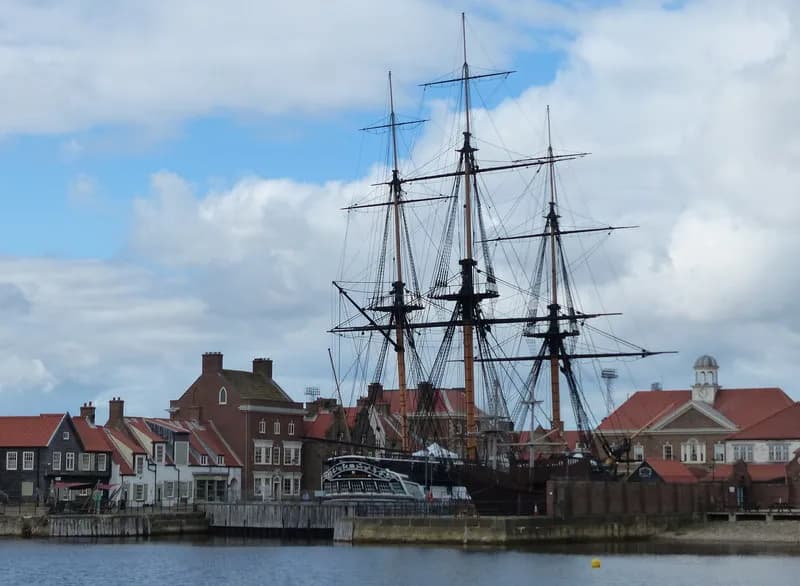
The marina's western end is dominated by the Royal Navy Museums, Hartlepool, which centres on two historic vessels. HMS Trincomalee, a Royal Navy frigate built in Bombay in 1817, remains Britain's oldest warship still afloat. Alongside her sits the paddle steamer Wingfield Castle, built in 1934 as a Humber ferry, which now serves as a floating exhibit and coffee shop.
The museum complex also includes period shops and houses, a Fighting Ships exhibition, a Children's Maritime Adventure Centre, and the Marine Barracks and Guard Room. In June 2016, the National Museum of the Royal Navy took over operation of the site from Hartlepool Borough Council, and in May 2026 the attraction was rebranded as Royal Navy Museums, Hartlepool.
The Marina Today
Contemporary Hartlepool Marina blends working maritime activity with leisure and culture. The waterfront is home to cafes, a bistro, and the Quayside Coffee Shop, while the surrounding area features public art including the Hart sculpture at the marina car park and the monkey statue, relocated from West Hartlepool in the 1990s, which collects coins for a local hospice.
The regeneration that began with the Teesside Development Corporation in the late 1980s has given Hartlepool a waterfront that draws visitors, supports local businesses, and preserves the town's seafaring heritage. From a site that stood empty for more than 20 years after the shipyards closed, the marina now serves as both a working harbour and a reminder of how targeted investment can reshape a post-industrial coastline.