From Shopkeeper to Shipbuilding Magnate
William Gray's rise from Hartlepool shopkeeper to one of Britain's most successful shipbuilders began with an unlikely partnership. In 1863, Gray, who had established a successful chain of stores in Hartlepool, entered into business with John Punshon Denton, who had founded a shipyard in Middleton in 1839. The resulting firm, Denton, Gray and Company, launched its first vessel on 23 January 1864.
The partnership dissolved in 1866 after a brief collaboration with other local firms. Following John Denton's death in 1871, the company was renamed William Gray & Company in 1874. Gray took his eldest son Matthew into partnership, establishing a family dynasty that would span three generations.
The Heyday of Hartlepool Shipbuilding
By 1869, the company had relocated to a larger yard in West Hartlepool covering eight acres and employing up to 1,200 men. The firm's ambition was evident; in 1878, William Gray & Company set the British record for shipyard output with 18 vessels launched in a single year. That same year, the yard achieved the distinction of launching the largest tonnage of any shipyard in the world, a feat it would repeat on several occasions.
The company's expansion continued apace. By 1900, employment had grown to 3,000 men across eleven slipways. The firm had built 200 ships by the outbreak of the First World War. Gray's success contributed substantially to West Hartlepool's rapid growth; the town's population reached 28,000 by 1881, whilst old Hartlepool had only 12,361 residents. By 1900, the two Hartlepools combined were one of the three busiest ports in England.
Vertical Integration and Innovation
William Gray & Company distinguished itself through vertical integration. In 1883, the firm established the Central Marine Engineering Works to manufacture its own marine engines. William Cresswell Gray, the founder's son, later expanded operations by purchasing the Milton Forge and Engineering Company and, in partnership with Sir Christopher Furness, acquired several iron and steel works. These were amalgamated into the South Durham Steel and Iron Company Ltd to supply materials for Gray's vessels.
The company became a private limited company on 1 January 1889, with William Gray serving as chairman. Recognition of his industrial achievements and charitable work came in 1890 when he was knighted. His son, William Cresswell Gray, was created 1st Baronet Gray of Tunstall Manor on 7 July 1917 following a royal visit to the shipyard on 14 June 1917 by King George V and Queen Mary.
Wartime Contributions
The First World War brought significant demands upon the yard. Between 1914 and 1918, William Gray & Company built 30 cargo liners and tramp steamers, 13 vessels for the Admiralty including four M15-class monitors, and 30 standard "War-class" cargo ships for the Shipping Controller. By 1918, the Central Marine Engine Works had shifted production to shell cases, employing mainly women in the manufacture.
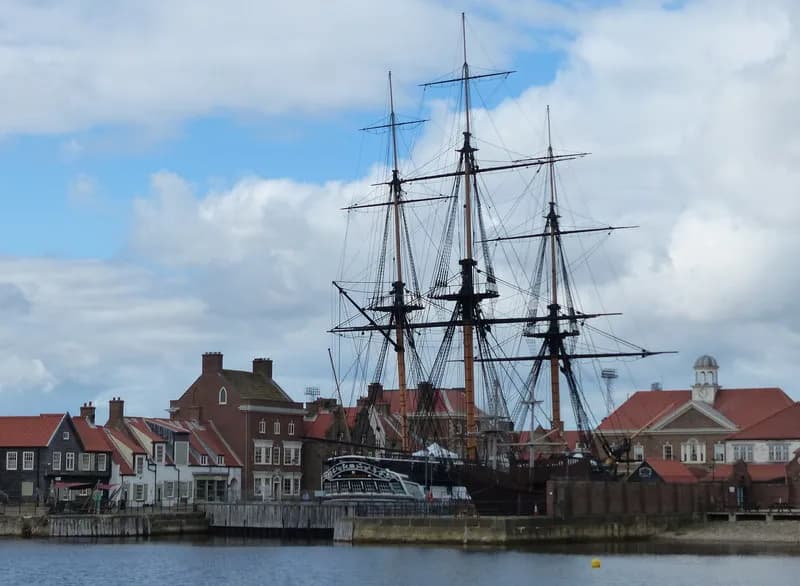
The company achieved its 1,000th ship in 1929. Notable vessels included the PS Wingfield Castle, launched in 1934, a 556 GRT paddle steamer that now serves as a museum ship at the National Museum of the Royal Navy in Hartlepool.
The Second World War and Post-War Decline
The yard experienced a revival during the Second World War, building 72 ships and repairing 1,750 vessels between 1939 and 1945. However, the post-war years proved challenging. The company built an average of only 7.5 ships per year between 1945 and 1959. By 1959, just two ore carriers remained on the order books.
The last ship, Blanchland, was launched in 1961. The company entered voluntary liquidation in 1962, with repair work continuing into that year.
Lasting Legacy in Hartlepool
William Gray & Company's influence on Hartlepool extended beyond shipbuilding. The village of Graythorp was constructed by the company to house workers at its shipyard on Greatham Creek, leased in 1913 and operational until 1963. The Graythorp dry dock, originally William Gray's shipyard basin, was purchased by Laing Offshore in 1969 and later by Able UK in 1996, now operating as a marine recycling facility.
The Gray baronetcy continues; the 3rd Baronet is Sir William Hume Gray, born in 1955. The PS Wingfield Castle remains preserved at Jackson Dock as a tangible reminder of Hartlepool's industrial heritage.