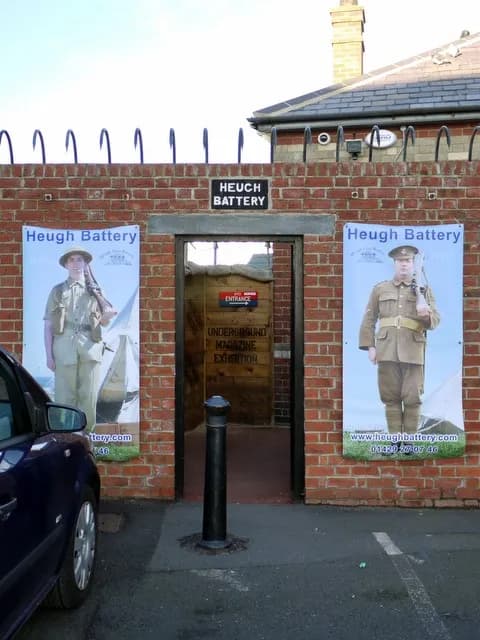
Heugh Battery stands on the Headland at Hartlepool as the only First World War battlefield on British soil. On 16 December 1914, its gunners returned fire against German warships in an engagement that killed more than a hundred people and changed coastal defence in Britain.
A Battery on the Headland
Heugh Battery was originally erected in 1860 to protect the port of Hartlepool, alongside Lighthouse Battery and Fairy Cove. The original armament consisted of 68-pounder smoothbore guns, which were later replaced by 64-pounder rifled muzzle-loading guns in the 1880s. In 1900, the battery was completely rebuilt to house two 6-inch Mk VII naval guns, with an underground magazine situated between the emplacements. A third 6-inch gun was installed at Lighthouse Battery in 1907, giving Hartlepool a trio of heavy coastal guns manned by the Territorial Force gunners of the Durham Royal Garrison Artillery.
The Raid on 16 December 1914
At 08:10 on the morning of 16 December 1914, the German battlecruisers SMS Seydlitz, SMS Moltke, and SMS Blücher, accompanied by the light cruiser Kolberg, opened fire on Hartlepool. The ships discharged approximately 1,150 shells into the town, striking the steelworks, gasworks, railways, seven churches, and some 300 houses. The attack caused the first death of a British soldier by enemy action on British soil during the First World War; Private Theophilus Jones of the Durham Light Infantry, aged 29, was killed while serving in the town.
Heugh Battery Returns Fire
The gun crews at Heugh and Lighthouse Batteries had been warned at 04:30 and issued live ammunition well before the bombardment began. Heugh Battery was the only gun battery to return fire during the raid, as German shells fell within 100 metres of its position. The gunners discovered that their shells could not penetrate the armoured sides of the battlecruisers, so they switched their aim to masts and rigging. Their fire was accurate enough to force SMS Blücher to take shelter behind the lighthouse; two of the ship's 15 cm guns were disabled, and its bridge and a 210 mm gun were damaged.
Casualties and Impact
The bombardment killed 86 civilians and injured 424 more. Seven soldiers were killed and 14 injured. The raid demonstrated the vulnerability of Britain's east coast towns and prompted a significant reassessment of coastal defence policy. It also became a powerful recruitment tool, as posters and newspapers used the attack to urge men to enlist.
The Museum Today
Heugh Battery closed as a military installation in 1956 and is now cared for by the Heugh Gun Battery Trust, which operates a museum and artillery collection on the site. The museum describes itself as the only battlefield of the First World War in Great Britain. A plaque on the coastal walkway outside the battery marks the spot where a shell fell during the engagement. In the 2020s, Historic England provided £40,000 towards a comprehensive structural survey to guide restoration work. The site relies on donations and volunteers to preserve its guns, magazines, and the story of the men who served there.